
We asked which English words language learners find hardest to remember, and why. We analysed more than 280,000 flashcards that learners had fully mastered in DuoCards, a flashcard app for learning languages. They cover about 450 English words and phrases and learners of 16 native languages. For each word, we counted how many times learners missed it before it stuck.
To reckon is the hardest English word to remember. Learners answered "I don't know" about 7 times before it finally stuck. That is about eight times more than for concrete words like apple or train.
Some words stick after one look. Others slip away again and again, even after weeks of practice. Teachers and learners know this from experience, but it is rarely measured at a large scale. This is the first edition of our yearly Memory Report, which measures it.
Five key findings
- Abstract words are the hardest. The most abstract third of words took three times more misses than the most concrete third.
- Rare words are harder. The rarest third of words took twice as many misses as the most common third.
- Word length does not matter on its own. Long words are harder only because many of them are abstract or rare.
- Your native language changes the list. Words that look like a word in your own language are much easier. Portuguese speakers, who say convencer, missed to convince less than once on average; Czech speakers 11 times.
- Close synonyms are a trap when both get the same translation.
The 10 hardest English words to remember
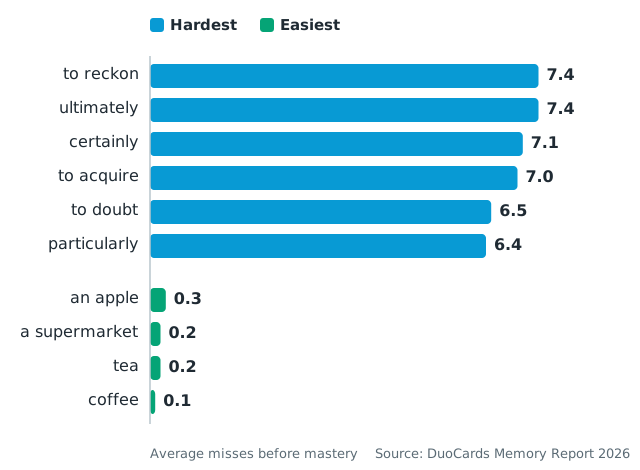
These are the words that took learners the most misses before they mastered them. Each number is an average over a sample of 150 or 400 mastered flashcards of that word from our English courses.
| # | Word | Misses before mastery |
|---|---|---|
| 1 | to reckon | 7.4 |
| 2 | ultimately | 7.4 |
| 3 | certainly | 7.1 |
| 4 | to acquire | 7.0 |
| 5 | to doubt | 6.5 |
| 6 | particularly | 6.4 |
| 7 | additional | 6.3 |
| 8 | fraught | 5.8 |
| 9 | to convince | 5.4 |
| 10 | to approve of | 5.3 |
Learners differ a lot, so a few of them who missed a word many times can raise its average. Words with similar numbers are about equally hard, and the exact order matters less than the list.
None of these words is a thing you can point at. They describe opinions (to reckon, to doubt), certainty (certainly), logic (ultimately, additional) or emphasis (particularly). Most of them also have close neighbours that are easy to mix up: certain, certainly and surely; to reckon, to think and to guess.
The easiest English words to remember
At the other end are words learners remember almost at first sight. Each is based on 150 mastered flashcards.
| # | Word | Misses before mastery |
|---|---|---|
| 1 | coffee | 0.1 |
| 2 | tea | 0.2 |
| 3 | a supermarket | 0.2 |
| 4 | yoga | 0.2 |
| 5 | a woman | 0.2 |
| 6 | every day | 0.2 |
| 7 | to work | 0.2 |
| 8 | big | 0.2 |
| 9 | an apple | 0.3 |
| 10 | together | 0.3 |
Many of them are international words: coffee, supermarket and yoga sound almost the same in most languages, and many beginners know them before they start. The others are concrete things and simple actions that are easy to picture.
What makes a word hard to remember?
To go beyond lists, we compared our results with three properties of each word: how abstract it is, how common it is, and how long it is. We could match 298 of our words with published ratings. To measure how strongly each property is linked to the number of misses, we used a rank correlation (Spearman's ρ). It runs from −1 to 1, where 0 means no link at all.
1. Abstract words are about three times harder
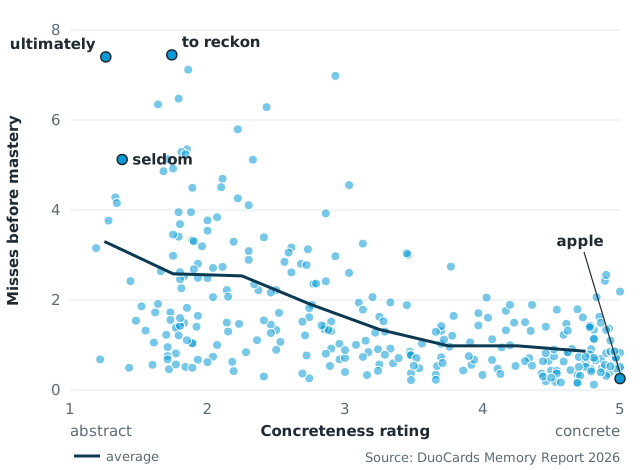
Brysbaert, Warriner and Kuperman (2014) asked thousands of people to rate 40,000 English words from 1 (abstract, like perhaps) to 5 (concrete, like apple). When we put our words on that scale, a clear pattern appears: the more abstract a word, the more misses it takes.
| Words | Example words | Misses before mastery |
|---|---|---|
| Most abstract third | perhaps, ultimately, seldom, to reckon | 2.6 |
| Middle third | often, to ask, expensive, together | 1.5 |
| Most concrete third | an apple, a bird, an umbrella, a train | 0.9 |
The correlation between concreteness and misses is ρ = −0.51: a strong link for real-world data. It stays at −0.53 when we take word frequency and length into account, so abstractness has its own effect. You can picture an umbrella, so umbrella is easy. Seldom has no picture, and its meaning only becomes clear in a sentence.
2. Rare words are about twice as hard
We also used word counts from film and TV subtitles (SUBTLEX-US, Brysbaert and New, 2009), a standard measure of how often people hear a word. The rarest third of our words took 2.3 misses on average, the most common third 1.2. The link is moderate (ρ = −0.37) and stays the same when we take abstractness and length into account.
3. Word length does not matter on its own
At first sight, long words look harder: the longest third took 2.3 misses and the shortest third 1.1. But this difference disappears completely once we take abstractness and frequency into account (ρ = 0.00). Long words are harder because many of them are abstract or rare, not because they are long.
These results match earlier research. In a well-known study, "What is hard to learn is easy to forget", Annette de Groot and Rineke Keijzer (2000) found that concrete words and words that look like their translation are learned faster and forgotten more slowly than abstract words. Our data shows the same patterns with real learners, outside the lab.
English words that German, Spanish and Portuguese speakers struggle with
The biggest surprise in the data is how much the list changes from one native language to another. The same English word can be one of the hardest for one group of learners and one of the easiest for another.
| Word | Hard for | Easy for |
|---|---|---|
| on purposegap 5.8 (4.3–7.4) | German (absichtlich): 8.2 | Italian (di proposito): 2.3 |
| to doubtgap 4.1 (3.1–5.2) | Polish (wątpić): 5.1 | French (douter): 0.9 |
| to convincegap 10.1 (7.8–12.4) | Czech (přesvědčit): 11.0 | Portuguese (convencer): 0.9 |
| accidentallygap 6.1 (4.4–7.8) | German (versehentlich): 7.7 | Spanish (accidentalmente): 1.6 |
| to acquiregap 3.5 (2.2–4.7) | Turkish (edinmek): 5.2 | Portuguese (adquirir): 1.8 |
| certainlygap 4.5 (3.2–5.9) | Spanish (definitivamente): 6.0 | Portuguese (certamente): 1.4 |
| seldom | most learners: about 5 | German (selten): 1.9 |
Misses before mastery for one group that found the word hard and one that found it easy, not always the two extremes. Each value is based on 123 to 250 mastered flashcards per language. The gap is the difference between the two groups, with its 95% range in brackets.
The pattern is clear: when the English word looks like a word you already know, it is usually much easier. Linguists call these words cognates. Many abstract English words come from Latin, so speakers of Spanish, Portuguese, French and Italian get a head start. The learners who struggle with these words are not weaker in general: German and Czech speakers are about average in our data. These words are hard for them because their own word looks nothing like the English one. It is not only about Latin either: seldom is easy for German speakers because German has selten. And even close languages can differ: in our courses, Spanish speakers learn certainly as definitivamente and needed 6.0 misses, while Portuguese speakers learn it as certamente and needed 1.4.
It also works the other way. Religion and transport are international words in most languages, but not in Czech, where they are náboženství and doprava. Czech learners needed 2.5 misses to master religion, while Portuguese learners, who say religião, needed 0.3.
How hard is English vocabulary for each native language?
We also compared each group of learners with learners of other native languages on exactly the same words. This removes the effect of learners studying different courses.
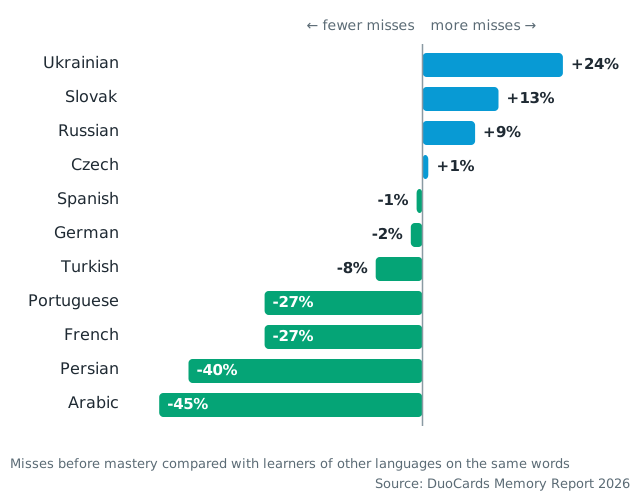
Misses before mastery compared with learners of other languages on the same words. Languages with at least 40 words to compare.
Speakers of Portuguese and French needed about a quarter fewer misses than other learners, which fits the head start their languages give them with Latin-based English words. Speakers of some Slavic languages, such as Slovak, needed more, while Czech speakers were about average. The large differences for Persian and Arabic speakers are harder to explain by language alone. Learners grade their own answers in DuoCards, so some groups may simply be stricter with themselves, and the learners from each country who use our app are not a random sample of that country. We therefore see this chart as a starting point, not a ranking of nations.
The synonym trap
Some words are hard not only because they are abstract, but because learners mix them up with a close neighbour.
English has especially and particularly. In some of our courses, for example German and Czech, both words had the same translation (insbesondere, zejména). A learner who saw that word had to guess which English word we meant. It shows in the data:
| Native language | Same translation as especially? | Misses for particularly |
|---|---|---|
| German | yes | 10.8 |
| Czech | yes | 12.3 |
| Turkish | no (özellikle) | 5.8 |
| Persian | no | 5.5 |
| Spanish | no (en particular) | 2.4 |
| Portuguese | no (particularmente) | 1.0 |
Particularly is hard for everyone, but sharing a translation added several misses on top. This one was our own mistake, and we are now giving the two words different translations. The lesson for learners stays the same: when two English words seem to mean the same thing, learn them together and note the difference.
Hardest English words for Spanish, Portuguese, German, Czech and Ukrainian speakers
The first column shows the words that took each group the most misses. The second shows words that were unusually hard for that group compared with learners of other languages.
| Native language | Hardest English words | Unusually hard for this group |
|---|---|---|
| Spanish | fraught, to look forward to, certainly, to reckon, moreover | a birth (nacimiento), the size (el tamaño) |
| Portuguese | fraught, seldom, ultimately, to reckon, scattered | a deer (cervo), to chill out |
| German | ultimately, fraught, on purpose, certainly, accidentally | as a result (infolgedessen), moreover (außerdem) |
| Czech | to reckon, to convince, on purpose, certainly, ultimately | a religion (náboženství), as a result, transport |
| Ukrainian | to acquire, certainly, ultimately, additional, fraught | the silence (тиша), immediately |
Hardest words: at least 150 mastered flashcards per word and language. Unusually hard: at least 100, and a clear difference from other learners. Words with a shared translation, like particularly, are left out.
Tips for remembering the hard ones
Long words are not the problem. Words get hard when they are abstract, rare, or look like nothing in your own language. Each of these has a fix.
- Learn abstract words in a phrase. You can't picture ultimately, but you can remember ultimately responsible. Put a common phrase on the card: particularly important, acquire a skill, I doubt it.
- Write your own sentence once you recognise the word. Make it true about your life: "I seldom eat breakfast." Your own sentence sticks better than one from a textbook. Wait until you know the word a little, because on the first meeting a sentence can distract you from the word itself.
- Look for a cousin in your language. To acquire is adquirir in Spanish and Portuguese and acquérir in French. Finding a cousin makes a word much easier. But watch out for false friends: actually means "in fact", not "currently" like the Spanish actualmente or the German aktuell.
- Learn look-alike words one at a time. If you learn especially and particularly on the same day, they blur together. Learn one first. When it feels solid, add the other and write one line about the difference, for example: "I doubt he'll come" (I think he won't) and "I suspect he'll come" (I think he will).
- Meet rare words on purpose. You won't often hear seldom or to reckon, so your reviews have to do the repeating. When you find one in an article or a series, add that sentence to its card.
- Test yourself and grade honestly. Say the English word before you turn the card. If you hesitated, mark it as not known. Honest answers are what let spaced repetition do its job.
Hard words simply need more reviews than easy ones, and that is normal. Spaced repetition brings each word back just before you would forget it, so even to reckon finally sticks.
For teachers: a free printable worksheet with the 20 hardest words, phrase practice, look-alike words and the six tips, with answers. Download the worksheet (PDF) · More resources for teachers
Want to practise the hard ones? Most of the words in this report come from two free DuoCards sets: Top 100 words (with ultimately, particularly, certainly, seldom and on purpose) and the Intermediate Course (with to reckon, to acquire and to convince). Add them to DuoCards, and spaced repetition will bring the hard words back until they stick.
Method
Data. Flashcards from the English courses in the DuoCards app, added between March 2021 and October 2026. DuoCards learners review a flashcard, try to recall the word, and mark whether they knew it.
Definitions.
- Mastered flashcard: a card that reached the last of the seven review steps.
- Miss: a review where the learner marked "I don't know".
- Misses before mastery: the average number of misses on mastered cards of a word.
- Native language: the language a learner studies English from in DuoCards.
Inclusion rules. We counted only mastered cards, so every learner in the data reached the same end point, whether they practised a lot or a little. Lists of single words use at least 150 mastered flashcards per word. Comparisons between languages use at least 100 per word and language. Full sentences were left out. In total: more than 280,000 mastered flashcards, about 450 English words and phrases, and learners of 16 native languages, 14 of them with enough data to compare.
Statistics. Links between word properties and misses are Spearman rank correlations, computed for the 298 words we could match with the published ratings. To check that a property has its own effect, we also computed partial correlations that take the other two properties into account. Differences between languages are reported only when their 95% range does not include zero. Language differences in the chart compare each language with all others on the same words.
Limits.
- Learners grade their own answers, and some may be stricter with themselves than others.
- Words that learners gave up on are not counted.
- Our sample is the first mastered cards found in our database for each word, not a random sample, so older cards and the largest learner groups have more weight. The per-language numbers come from slightly different samples.
- We measure how hard a word is to learn until it sticks, not how fast it is forgotten later.
Privacy. We worked with aggregated counts only. No individual learner can be identified, and no learner data was exported or published.
References
- Brysbaert, M., & New, B. (2009). Moving beyond Kučera and Francis: A critical evaluation of current word frequency norms and the introduction of a new and improved word frequency measure for American English. Behavior Research Methods, 41(4), 977–990. doi.org/10.3758/BRM.41.4.977
- Brysbaert, M., Warriner, A. B., & Kuperman, V. (2014). Concreteness ratings for 40 thousand generally known English word lemmas. Behavior Research Methods, 46(3), 904–911. doi.org/10.3758/s13428-013-0403-5
- de Groot, A. M. B., & Keijzer, R. (2000). What is hard to learn is easy to forget: The roles of word concreteness, cognate status, and word frequency in foreign-language vocabulary learning and forgetting. Language Learning, 50(1), 1–56. doi.org/10.1111/0023-8333.00110
Use this data
Feel free to use the numbers, tables, charts and cover image from this report in articles, lessons and presentations. Just credit "DuoCards Memory Report 2026" and link to this page.